Monday, January 30, 2006

American-Made Blue Jeans

It’s hard to imagine a wardrobe without denim jeans. What started out as hard-working wear for men has evolved into a fashion basic for men, women, and children. The old-style dungaree (from the Hindi “dungri” meaning a coarse cloth) is still around, but increasingly the jeans market is dominated by stretch denim that dresses up or down.

Denim trivia: if you look closely at your jeans, you will see that the denim has a diagonal pattern in the weave. As every school kid knows, weaving takes a filling yarn over-under-over-under the warp yarns (the same technique applies to lattice pie crust!). For denim and other twill fabrics, however, the filling yarns go under and over two or more warp yarns. This creates an offset pattern from one row to the next. The addition of spandex fibers allows the denim to "give."

American jeans used to mean Levi, Wrangler, and Lee, to name a few. Today, Levi jeans are made overseas. Wrangler and Lee brands are owned by VF Corporation, which also owns Chic Jeans, Riders, and Rustler brands. VF Corp. has manufacturing plants located in the United States, as well as other parts of the world. So, while MAY be possible to find a pair of Wrangler or Lee jeans made in USA, it’s a bit like looking for a needle in a haystack. Likewise, jeans made for LLBean, Landsend, and the GAP are imported.

Luckily, there are a surprising number of American-made jean options available. For a definitive (almost) listing of jeans still made in USA, see Stephanie's Guide to American-Made Jeans. (I tried to include the tables here, but blogger doesn't seem to like them!) I have divided the brands into two categories: traditional “serious” jeans and up-scale luxury jeans. Admittedly, my groupings are somewhat arbitrary, but jeans that cost over $100 a pair (and some up to $200 a pair) cry out for special treatment!

There is a confusing array of these luxury jeans, featuring hand sanding, grinding, and “destroyed effects” (i.e., the price includes having someone wear them out for you!). I did not find much to distinguish among the high-end, couture jeans; all the brands I list appear to be made in USA from imported (primarily stretch) denim. One stand-out is Truck Jeans, a brand of fashion jeans made in USA from imported denim, offering blasted and “destroyed” effects for under $50. The label in my Truck Jeans says “Made with American hands in the USA.” How cool is that?!

Here's an interesting article on the booming luxury jeans market: Explosion of pricey premium-jeans market has created intense competition and, some say, a bloated inventory for retailers. By Jennifer Davies (San Diego Union Tribune, October 5, 2005)

One final note. I did not include USA Works jeans in the table because they are presently being imported. However, Sapko International, which makes USA WORKS, says they are on track to restart USA production (in Wisconsin) and hope to begin shipping domestic USA WORKS by late third or early fourth quarter 2006. I’ll update the table as soon as I get confirmation that American-made USA WORKS jeans are once again available. (I took down the Blog Poll on whether or not we should buy imported USA WORKS to show support for the company. The results were 50% in favor, 42% opposed, and 8% undecided. Since that time, the company has posted a note on their website with their commitment to restart US production as soon as possible--yeah!!)

As always, I welcome comments, additions, and corrections. Let me know what you think of Stephanie's Guide to American-Made Jeans.

Monday, January 23, 2006

Village Traditions: Celebrating Craftsmanship and Natural Materials

Visiting VillageTraditions.com is like taking a leisurely trip through the unspoiled countryside of northern Vermont. The site offers simple, beautiful products made from clay, wood, and leather. Creamy pottery and hand blown glass by Simon Pearce, bowls of cherry and walnut, pieces of Vermont slate, and handspun pewter bowls and vases. The pieces seem carefully selected to please the eye and sooth the spirit, and many are made in Northern New England.


For the Italiano-files among us (just call me la Bella Stephania!), VillageTraditions also offers a sublime selection of handmade Italian pewter cutlery and soft Italian leather goods. The shopping experience is made perfect by the many beautiful photographs of the Shelburne area. Take a trip with your mouse, feel the tranquility, and reconnect with the timeless beauty of goods made by hand from natural materials.

Friday, January 20, 2006

Organize This!

Today I received an email that shouted: “Make Your Home Clutter-Free!” “Tackle Your Toughest Storage Tasks!” “Shop Our Problem Solvers Collection Today!” Now how in the heck did they know? Have they been peeking??

Okay, I admit to having an “organization problem.” Not for lack of purchasing various organizers, however. Just last week (and, no, this was NOT a New Year’s Resolution!) I went off to Staples and bought a lovely storage/filing container (HOMZ, made in USA) and some pocket folders (made in Mexico). The idea was that I would file newspaper clippings, story ideas, USA-made product information, and correspondence and reintroduce myself to my desktop. As evidence that buying organizers can motivate, energize, and organize me, I attach the following Before and After photos. Can you tell the difference?!


[January 21, 2006: UPDATE! I received an email today about an organizational "life-in-a-binder" system called JOYS: Just Organize Your Stuff. The website says "JOYS is committed to providing high quality, fairly priced, made in the USA products." It looks like a very well thought out set of checklists and reminders, packaged in a beautiful binder. Check it out! Maybe there's hope yet . . .]

Music to get you going on Friday after a tough week—and it WAS a tough one. (Though I am thankful not to live in Russia, where temperatures are 20 below, and not to be a coal miner.)
"Everything, everything will be just fine
Everything, everything will be alright"
--from The Middle, by Jimmy Eat World, the “Bleed American” album released July 2001.

New additions to StillMadeinUSA.com this week:

Stephanie's Valentine Gift Picks!

Auburn Leathercrafters (Auburn, NY)

Drew’s Boots (Klamath Falls, OR)

Eldreth Pottery (Lancaster Co., PA)

Hartstone Pottery (Zanesville, OH)

Louisville Stoneware (Louisville, KY)

Our American Heritage (Paoli, PA)

Soft Star Shoes (Corvallis, OR)

Keep those emails coming—it’s great to hear about companies that I can list! Next week: Product Reports and a summary of American-Made Blue Jeans. Have a good weekend!

Thursday, January 12, 2006

Hartstone Pottery is Back!

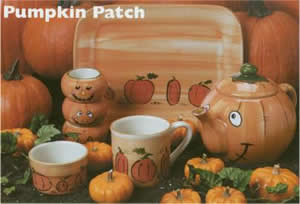
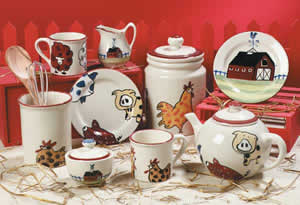
My first virtual catalog, posted for Fall 2004, featured hand-painted pottery by Hartstone Pottery of Zanesville, Ohio. I loved their Pumpkin Patch pottery design for autumn celebrations. I also included their Funny Farm pattern in the StillMadeinUSA.com 2004 Holiday catalog.

Hartstone Pumpkin Patch

Hartstone Funny Farm

Then, in 2005 I was distraught to hear that the pottery was being closed by its parent company, Carlisle Home Products. In past years, Hartstone Pottery had made blueberry pottery for LLBean and hand-painted soup tureens and other pieces for Crate and Barrel. As these larger accounts were lost to cheaper imported pottery, the Pottery struggled to remain profitable. Finally, Carlisle Home Products decided to pull the plug.

The closure of Hartstone Pottery not only meant the loss of jobs in Zanesville, but the potential loss of an artistic heritage in an area with a long history of handmade, hand-painted pottery. I also learned that the closure was impacting local potters who had relied on the Hartstone kilns to have their own pottery fired. I resorted to EBay to buy up a few pieces of Hartstone Funny Farm, while sending offers of free web advertising to Carlisle and Hartstone, and urging support for the company on local web boards. I didn’t have much hope that the company could be saved.

But, finally some good news. An article in the local Zanesville paper reported that a group of investors was working to save the pottery. Today I checked back, and was delighted to see that the Hartstone website is back on line! The Original Hartstone Pottery has reopened and is producing a limited number of their pottery patterns. I am hoping that more will come on-line as they grow the business. If you love hand-painted pottery, here’s your chance to support a wonderful enterprise. Welcome back, Hartstone Pottery!

Wednesday, January 11, 2006

Why I'm Drinking More Coffee in 2006

For those who felt that I set my sights too low for 2006, here is an important "news story" (Disclaimer: not a true story) by David Deckert. Enjoy!

SEATTLE (PA) -- SEATTLE MAN ARRESTED FOR INDECENT EXPOSURE -- Police in downtown Seattle arrested a man for indecent exposure today. Mr. Michael Feldman of 714 SE James St., was arrested after police determined that he was carrying neither a cellphone nor a latte. He was taken into custody and cited with criminal non-possesion of caffeine and failure to provide an annoying ring melody in a public place. He was later fined and released under his own recognizance.

Police first became suspicious of Mr. Feldman after they observed him briskly crossing a busy street at a crosswalk while failing to stop and hold up traffic. The officers reported that since Mr. Feldman did not seem to be carrying any sort of coffee they stopped him for questioning. A brief search determined that neither was he carrying any sort of communication device.

"He didn't even have a pager," said Officer "Buck" Simmons of the Seattle Police Department. "We figured he must be one of them anarchists, so we gassed him just to be on the safe side."

Mr. Feldman apologized for his actions and said that he hoped that no innocent bystanders had been affected. He explained that the unexpected sunny weather had "put him out of sorts" and that he had neglected to don his cellphone before leaving the house. Mr. Feldman later told reporters, "I guess I was too busy looking at that blue sky." Said Officer "Buck" Simmons, "He just kept looking up. Like at the sky or something. We thought he was a psycho."

A similar incident happened last month when a Mr. Jeffrey DuChamp was arrested and faced the same charges. Those charges were later dropped when it was discovered that Mr. DuChamp was Canadian, and he was summarily deported.

Tuesday, January 10, 2006

Mapping Visitors to StillMadeinUSA.com

Yesterday I discovered a really COOL little web techy tool that produces a map of the most recent 100 visitors to my website, StillMadeinUSA.com. The service locates IP addresses on top of Google maps to provide a geographic view of the location of visitors to my site. There is no end to the wonderful bits of code that are available for free!

Check it out by clicking on my visitor log. If you’re looking for yourself, be aware that the data only updates every few hours. Isn’t this fun??!!

While on the topic of websites and techy developments, I pass along this prognostication from Scott Adams (quoted from his 1997 book, The Dilbert Future)

“In the not-too-distant future, anybody who doesn’t have their own home page on the World Wide Web will probably qualify for a government subsidy for the home-pageless.”

So, if you are webpage-deprived, make 2006 the year that you get a homepage, get a blog, or at least get a mapped visitor log! Happy New Year (again, still)!


Sunday, January 01, 2006

Happy New Year, 2006!

That popping sound was the housing bubble bursting, but I’m not worried because I’m diversified (I own GM stock). All the columnists (the paid variety, that is) are reminding us of Tsunami and hurricane aftermaths, union-busting, outsourcing, wars and death. I choose to leave 2005 summarizing and hand-wringing to them, and focus on 2006.

Back when I worked in cubicle land, I used to post my New Year’s Resolutions outside my work station to forewarn my co-workers. Heading the list every year was “Be nicer.” Number 2 was usually “Keep my workspace clean,” followed by “Exercise more.” My friends know that I never kept any of these resolutions. Now that I am older and wiser, my resolutions are much more practical. So here goes:

2006 Resolutions

  • Drink more coffee, and make sure it’s not tested on animals.
  • Stop donating money to every cause that knocks on my door. (This per my financial advisor, Bob Tresley.)
  • Start as many projects as I want without feeling guilty if I don’t finish all of them.
  • Apply my Type-A, detail-oriented, dictatorial skills to helping people who don’t even know they want help.
  • Write to politicians.

I have an unshakeable conviction that 2006 will be a great year. People (and I include Republicans here) are basically good, talented, and hard-working. We have a lot of things to work on (raising living and working conditions, educating our kids, decreasing our effects on the environment), but we’re going to get there. I’m confident that I can make a difference, and have fun doing it. So I raise my glass of Sparkling Cider and wish all of you a Happy New Year!

Saturday, December 31, 2005

Childhood in a Tin Box

Christmas is a lot about nostalgia and memories. My mom serving my grandmother’s suet pudding with hard sauce. The Christmas stockings that my other grandmother made for us kids. Remembering the year that Santa brought me the small white portable record player, and the stack of Nancy Drew Mysteries (which I sat down and read cover to cover).

This year, Santa brought my son a set of Jacks. They are beautiful gold and silver jacks, with rounded points and a heavy feel. They came in a tin with 2 red rubber balls. My sister and I sat down on the floor to demonstrate how to play. It reminded me of days sitting on the linoleum floor of Mom’s kitchen playing jacks, only ours had sharp ends and we had used a high-bouncing superball.

This time we found that we had lost the knack. Our tosses were wild, we scooted for position on the floor, we strategized over which jacks to pick up, we dropped some, our hands felt stiff. We were playing like middle-aged women. But after a few games, we stopped thinking so much and fell into the rhythm of the game. Our hands remembered what it felt like to be a kid. Toss, swipe, bounce, catch. I always loved the sound of the game. Of course, by this time the kids had wandered off to play their electronic games.

I picture Santa with a special twinkle in his eye as he dropped the jacks into my son’s stocking. Maybe, just maybe, they were really meant for me. Thank you Santa, and thank you Channel Craft.

Tuesday, December 20, 2005

Buying American for Christmas

Last week, the Commerce Department announced that the U.S. trade deficit reached $68.9 billion. This is such a large number that most of us can’t really comprehend it. A significant part of the trade deficit arises from our nation’s insatiable demand for imported oil. Another component of the trade deficit, however, is consumer purchasing of imported clothing, electronics, and toys.

As we send our consumer dollars overseas, our textile mills fall silent, our furniture makers struggle, and our potteries close. Quintessential American brands--like Levi's, Singer, Lionel, Timex, and Oneida—are no longer made in the USA. What’s more, most consumers don’t seem to know or care where things are made.

StillMadeinUSA.com is my attempt to help consumers find American-made consumer products. I don’t spend a lot of time trying to convince people to buy American, but I try to make it easier to do. I also try to lead by example, so here is an update on my holiday shopping: of the total dollars spent, 84% made in USA, 9% made in Mexico, 7% made in China.

Vendor

Product Origin

BuyAmerican.com

USA

Union Jean Co.

USA

Northeast Knitting Mills

USA

TheUnionShop

USA

Hasbro Games

USA

Cardinal Games

China

JCPenney

USA

CWDKids

USA

ColumbiaKnit

USA

GC game

USA

DS game

Mexico

Skooter

China

FisherPrice

Mexico

Flying Shuttle

USA

Channel Craft

USA

Fisher Space Pens

USA


We can choose to support American companies and American workers.

Friday, December 16, 2005

Putting the "Ho" back in Holiday

Don’t we have real issues to debate, or must we argue about how to greet each other during the holiday season? And yes, the phrase “holiday season” implies (correctly) that there is more than one holiday being celebrated this time of year. I have no problem with people who want to wish non-Christians a Merry Christmas, or gentiles a Happy Hanukkah. It’s the thought behind the greeting that counts. (I’m still feeling teary-eyed over the email I received today that says “Happy Holidays from Pizza Hut!”.)

As we rush around in our busy lives, saying Happy Holidays, Merry Christmas, and Happy New Year is shorthand for “I hope you are well and happy, and safe within the circle of friends and family.” So let’s stop fighting the Culture Wars, be nice to each other, and get back to shopping!

Wednesday, December 14, 2005

The Shipping Grinch

Like many of you, I have been doing a lot of holiday shopping on-line, mostly at StillMadeinUSA.com (shameless plug for my site!!). I was keeping an eye out for high shipping costs because of higher gas prices this season. Sometimes I find that sites with lower product prices have higher shipping or vice versa, so it pays to check the final totals before deciding where to buy. (Note that the shopping comparison sites don't take into account shipping costs...)

I did encounter an unexpected glitch associated with the “buy American” sites—total shipping charges were much higher than those charged by major retailers. For example, on an order where my purchases totaled $167, the shipping charge was $31! By way of comparison, typical shipping charges (by LLBean, REI, etc) for this purchase total average closer to $12! The reason for this became apparent when I completed the order and was notified that the products would be shipped from the individual manufacturers. In other words, the shipping savings normally associated with consolidating orders had been lost.

So, why is this happening? The advent of the Internet has meant that “virtual stores” can be set up where orders are shipped directly from manufacturers rather than from a retail middleman. This practice is called “drop shipping.” A benefit of drop shipping is that e-retailers are not required to invest in goods up front, and thereby forgo the risk of getting stuck with merchandise that doesn’t sell. There is also much less capital investment required. The e-retailer, in this scenario, becomes more of a service that coordinates transactions between customers and manufacturers. More of the burden for order fulfillment (tracking and shipping) is shifted to the manufacturer.

The absence of a “brick and mortar” store does have benefits for consumers because these e-stores potentially can offer a wider array of products. For the “buy American” niche, this is particularly helpful since many American-made products are not carried by traditional retailers. (I suspect this is because the profit margin is much lower than for imported products, but that’s another post.) All in all, then, I concluded that the extra charges were worth it because I saved shopping time by having all of the items available in one purchase transaction. However, it still came as a shock at check out. I think these stores need to better prepare customers for the Shipping Grinch.

Wednesday, November 30, 2005

Elves Organize, Join UAW

North Pole.Santa Gettelfinger This week Santa’s Elves voted to organize and form a union, reacting in part to concerns that “The Boss in Red” might decide to outsource toy production. In the words of one elf, “If that happens, the jobs go south!” The small workers researched possible unions to affiliate with, but in the end decided on the UAW. “We make cars and trucks, as well as trains and dolls, so it seemed like a good fit” said an elderly elf. Rumor has it that the other deciding factor was that Ron Gettelfinger is just so darn good looking!
The newly formed UAW Local 90N invited me to become an honorary member and informal spokesperson because of my elfin qualities, extreme interest in toys, and years of experience dealing with bad little boys. I promised to help get the word out about the need to improve working conditions at the Pole. For the most part, Santa is a beneficent taskmaster, but thinning of stratospheric ozone and global warming have the elves worried. “We’re also running short on coal for stockings of bad little girls and boys,” said one elf. “We’re trying to develop a solar-powered substitute, but it just doesn’t have the same impact.”

So, you heard it here first. Collective bargaining at the North Pole. What next—health care for everyone? Support your local elves this holiday. Do your shopping at StillMadeinUSA.com!

Friday, November 18, 2005

No More Parenting Tips--Please!

Every month our elementary school sends home a newsletter that gives updates on all the activities at the school (including a lot of long-term homework projects that I haven’t heard about…) The newsletter usually has a section with useful little tips on how to “Help Children Learn.” The tips always seem to be written by earnest young education professionals who HAVE NO CHILDREN, or at least only have girls.

This week’s tips included a call to “Build your child’s school skills during family meals.” By family meals I assume the author means the placement of food on a centrally located table so that children can come and go and take whatever meets their exacting culinary standards and eat it in front of the TV?

My favorite tip was the one about suggested activities during mealtime, and--as Dave Barry would say--I am not making this up!:

“Place an interesting object in the center of the table to encourage conversation.”

I don’t know about you, but the interesting object in the center of my table is a Lazy Susan, placed there to allow 360-degree access to the ketchup bottle. It does tend to be a conversation starter, though, since the favorite activities involving the Lazy Susan are:

1) Turn it just as a brother is about to grab the ketchup bottle;

2) Spin it so that the handle of the serving spoon in the bowl of peas knocks over a brother’s glass of milk; and

3) Jiggle it so that the petals of the dead rose in the “vase” fall into a brother’s food and/or the pepper mill falls over and rolls off into the mashed potatoes.

Maybe I should start a parenting newsletter of my own.

Thursday, November 17, 2005

Woolrich, Inc.---Then and Now

The Woolrich, Inc. website has an inspiring Flash history of the company, from its early days in the 1830’s as a supplier of rugged, warm woolen cloth and clothing to loggers and frontiersmen. Images of steam engines, mountain climbers, and the woolen mill in Woolrich, PA fade out and the image of “Woolrich Today” comes into view. The site proudly notes that the Woolrich Woolen Mill is one of the oldest in the U.S.A. What the history doesn’t say is that the march of progress has included almost total outsourcing of production.

After searching in vain on their website for anything that was made in USA, I resorted to “Live Chat” and here is what I was told:

“For American apparel companies to survive and grow in this past decade and in the future, we have all had to become truly global. Our company has been able to increase American employment in marketing, merchandising, administration, and retail. Although we manufacture many of our garments (or components) overseas, they are designed by us and meet our strict quality standards and specifications. We employ 850 people in the U.S.A, and we strive to keep as much manufacturing here as possible, but companies today have little choice but to compete in a global economy. When consumers choose to purchase Woolrich products, even those products made in foreign countries, they continue to support our 850 American employees.”

The bottom line is that, with the exception of a few huntwear and blanket items, Woolrich (“The Original Outdoor Clothing Company, celebrating our 175th year”) is now primarily a retail outlet for imported products. Still, I am glad they have managed (so far) to keep the mill going. I notice, for example, that their Civil War reproduction fabrics are still made in the Woolrich, PA mill…

Wednesday, November 16, 2005

Economists are People Too

For those of you who have noticed my absence from the blogosphere, my excuse is that I have been hip-deep in economics papers. Today I emerge to share a few insights about economists as a group (definitely not referring to any particular economist who happens to be my professor at this time, Dr. Dimitri, and is a wonderful person!).

Economists like to write very long papers, perhaps in the hope that readers will not stick it out through the middle part. The papers begin with broad, visionary statements about how markets function in theory. Then comes a lengthy, dense, mathematical presentation of how this theory would look in mathematical form. Rather than state the obvious in English, there are equations with Greek letters, many tiny subscripts, “dummy” variables, and terms that stand for “everything else that may be important, but which I have no idea about” (called “error” terms).

Then, for readers still standing after the theory section, comes a discussion of why none of the afore-mentioned variables will be used in the actual analysis because such data do not exist. (At this point, one hears screams or cries of anguish.) The conclusions section returns to the visionary statements introduced at the beginning, thus reassuring the reader that the intervening jungle has not lessened the certainty of the economist in the least.

Other observations: In order to be published, all economics papers MUST include the following terms:
  • ceteris paribus: this is a problem since I have no idea what ceteris paribus means! (My high school stopped offering Latin the year I arrived.) Based on context, I have decided that it means "assuming away all realistic ideas of how the world works"
  • endogeneity: something in the “real world” that intrudes on the tidy world of theoretical modelers and causes distress by violating the modeler’s assumptions that it can be specified and held constant
  • internalizing the externalities: I translate this to mean “taking account of all of those things which are not being taken into account” (??!)
  • marginal social cost: the cost to the rest of us when businesses are forced to “internalize the externalities” rather than take it out of their profits
[Disclaimer: this is just me having fun. If you want the REAL definition of these, and other, economic terms, check out this Glossary of Economic Terms.] The clear implication here is that I need to take more economics classes.

Energy update: Thanks to Bob Tresley, my windows and doors are weather-stripped, MOST windows are actually closed, and my programmable Honeywell thermostat is installed and functioning. I’m enjoying coming down in the morning to find that the room temperature has already risen to a comfortable level. One other electricity saver was installing power strips around the house so that clusters of electronic gizmos (TVs, computers, VCRs, PlayStations) could be turned off over night. However, this latter is not automated and there are serious implementation glitches. (Note to Honeywell: develop programmable husband.)

Wednesday, November 02, 2005

Thursday, October 27, 2005

Perspectives from Pumpkin Creek Clothing

Outside the small town of Pinehurst, North Carolina, the family-owned Pumpkin Creek Clothing Company manufactures and sells knit clothing. In addition to a "brick and mortar" store, their great products are available on-line at Pumpkin Creek Clothing and Red H'Attitudes. I love their turtlenecks, which come in lots of colors and are totally soft, 100% cotton. The prices are almost unbelievably low because they have cut out the retail middlemen. In addition to great products at great prices, owners Darrell and Susan Marks care about keeping production in the USA. But, some days they wonder. . .

Does Anyone Really Care About the ”Made In The USA” Label?
by Darrell Marks, Pumpkin Creek Clothing Co.

In addition to our two web-sites, where all of the clothing featured is made in our own factory, we sell directly to the public from our 10,000 square foot outlet store. We are visited by hundreds of shoppers each week who come not only for the things which we make, but those selections Susan has gathered from the markets she attends. Although the customers may be too many to count, the number who are concerned about the country of origin of their purchases is not. It is very small, almost non-existent. The majority look at the styling first, the price second, and to their companions for their approval third. Where something is made is no longer a concern to almost anyone.


Is this a good or bad thing?

For someone like myself, who has been in garment maunfacturing since 1969, it is a bad thing. I have seen the once great American manufacturing system succumb to the demand of the Giant Walk-Marts, to whom price is everything. Thousands of good manufacturing plants, and all of their workers, have fallen prey to cheap foreign imports. Those that could not compete have gone the way of the horse drawn carraige, the telegraph, and free TV.

Being a ”the glass is half full” kind of guy though, I see the other side. Garment prices to the public are cheaper now than they were 10 years ago. Sure, people have been forced into jobs which they may have not preferred, but others have been able to afford a better life style because they are spending less on clothing and other commodities.

And we have survived, in an industry that is dying. How have we done it? By working long and hard, by being innovative and creative, and by refocusing our market. We quit making clothing for others to mark up and profit from, choosing to sell directly to the public at factory prices. The price I now receive is the same stores paid me years ago, but the customer pays no mark-up, thus my prices compete quite well with ”cheaper” imports. We both win. And for those of you who still feel ”Made In The USA” is important, the best of both worlds.

Tuesday, October 25, 2005

News from the Afghani Front

This is an excerpt from a letter written by my friend's son, who is stationed in Afghanistan...

October 25, 2005

So now that the deployment is almost over, I can look back with pride and say we accomplished . . . Um . . . Uh-oh.

This is a strange war we’re fighting here. The stuffed-shirts at the Pentagon go on and on about how the Taliban are on the run and we’re winning the war on terror and bringing democracy to the Afghan people, and then the media jumps in and says no, the Taliban are gaining strength and importing Jihadist techniques and soon they’ll be unstoppable, and for the average soldier on the ground the only possible response to all of it is, “Huh?” Where is all this happening? Probably the only similarity between the typical GI and the typical Afghani is that neither of them knows what the f**k their leaders are talking about.
. . .
This is what most missions are like: a bunch of American soldiers come thundering into a stone-age village dressed like warrior mercenaries from outer space looking for a guy whose name they can’t pronounce because someone’s brother-in-law’s uncle’s cousin fingered him as a Taliban; The soldiers don’t find the guy because he’s moved to Pakistan, but they do find his brother. So they detain him and start asking questions. None of the answers they get make any sense because their interpreter speaks bad Dari and worse English, but it doesn’t really make any difference because the guy’s lying his head off anyway. Taliban? Who? Never heard of them. He’s just looking for the right words that will make the Americans go away. But you know what? When Taliban fighters pass through his village (and they do pass through his village) he tells them exactly what they want to hear, too. Because all the guy wants is to be left alone.

But in the end the soldiers decide to take him in for further questioning. So they load him up in a Humvee and start heading back to base. Maybe as they leave they chuck some soccer balls out the windows for the kids. Everyone in the village gets a big kick out of that, except for the two kids standing in a doorway crying because their dad is being taken away by foreign soldiers. But, oh well. And that’s it. No shots fired and the whole thing takes about three hours.

. . .
All my griping aside, I am actually hopeful for Afghanistan’s future as we prepare to head home. The elections went off without violence, the government seems committed to democracy, the Afghan Army is slowly improving, and most importantly, the people themselves seem sick to death of fighting. I think things will turn out all right here. If I ever run into the mother of one of the soldiers who died on this deployment, that’s probably what I would tell her – things will turn out all right, and somehow, in some way, your son helped to make that happen.

Friday, October 21, 2005

Week’s End

It’s Friday, so I’ll keep my sentences short. American manufacturing is on its own today, cuz what I’m thinking about is:

  1. WHAT THE HECK IS APPLE DOING getting rid of the iPod Mini??!! The new iPod Nano is cute and all, but it only comes in black or white. That’s SO yesterday. Bring back the colors! Good thing I got my pink iPod Mini this summer. Here’s a great little video about iPod, made by video artist George Masters, catchy tune by a Welsh band: check it out at http://www.gomotron.com/special/ipod.html
  2. More music: I’ve been spending a lot of time listening to the Fall Out Boy song, “I’ve Got a Dark Alley and a Bad Idea that Says You Should Shut Your Mouth.” In addition to a great title, the song sounds a lot like early Elvis Costello. What a treat. If iTunes is too establishment for you, check out new music at http://www.independentradionetwork.com/artists.php
  3. GO SOX!!!! My interest in baseball comes and goes. Sort of an “Easter Catholic” when it comes to sports. But, you bet I’ll be watching Saturday night.
  4. Saving Energy: The weather is turning cooler and I am tempted to turn on the heat. But, thanks to some of the email from readers this week (“just a bored housewife” indeed!!), I am feeling pretty warm!
Have a good weekend!

Tuesday, October 18, 2005

USA WORKS Dilemma

[Read the update on USA WORKS, February 22, 2006]

[Update: December 7, 2005: As of this date, Sapko, makers of USA Works Jeans, has not placed a statement on their website about their intentions to restart jeans production in the USA. In addition, Hanks Clothing, which had been offering customers the option to specify "American-made only" when ordering USA Works Jeans now tells me that they no longer have sufficient stock of American-made USA Works jeans to offer this option. It was great while it lasted, so thanks to Hanks for making the extra effort...and, note that Hanks still has a Made in USA page to help customers find American-made products that they carry.]
--------------
Last year I bought a pair of USA WORKS jeans because I knew they were made in USA. I loved the quality, the colorful red-white-blue patch on the back pocket, and the price (under $20). The colorful pocket card said, “Made by Hard Working Americans for Hard Working Americans.”

My first inkling of trouble was a note on Hanks Clothing.com, where customers were being offered the option of specifying American-made or import versions of USA WORKS. The site mentioned a fire at the jeans factory that had put the company out of commission for the time being.

About a week ago, I received an email from a disappointed consumer who had ordered several pairs of USA WORKS jeans based on information on my site that they were made in USA. When the jeans arrived, the label said “Made in China.”

I did some investigating, and here’s the scoop. The USA WORKS jeans were made in a factory in Tompkinsville, KY by Sapko International Inc. (headquartered in Sturtevant, WI). In February 2005, there was a fire at the plant and it was heavily damaged. Sapko’s head of supply chain management, Chris Baumgarner, tells me that the company intends to rebuild the Tompkinsville plant as soon as they settle things with their insurance companies. However, he estimates that restart of production at the facility might not occur until mid-2007.

In the mean time, the company felt that it needed to continue to produce USA WORKS jeans to meet the needs of its retailers and customers. According to Baumgarner, “The importation of USA WORKS is not our favorite choice, but due to limited USA production it was our only choice.”

Sapko brands also include FiveBrother work shirts, many of which are made in USA, and Williams Bay outdoor clothing, made in Wisconsin.

The temporary importation of USA WORKS jeans poses a dilemma for both retailers and customers. “Buy American” retailers, such as AmericanMadeForYou, have decided not to carry imported USA WORKS jeans although this brand was a substantial part of their offerings. Others, including Hank's Clothing, have continued to offer customers the option of specifying that they will accept only American-made USA WORKS, understanding that their order may not be filled.

Consumers face a similar dilemma. Do we continue to support the company by buying their products, even though imported (at least partially from China), because of their commitment to rebuild their US sewing factory? Or do we switch out allegiance to other jeans manufacturers that are still producing in USA (e.g., Union Jean, PointerBrand)?

I think this is an important discussion to have, and I’m not sure what the answer is. However, I feel that we owe the company some loyalty during a tough time. Think about the issues, then vote in the poll to the right. I also encourage you to post a comment to share your reasoning with others.

Wednesday, October 12, 2005

Cyber Communities

Lots of sociologists are already studying the formation of “virtual communities” on the world wide web, so I don’t wish to tread on anyone more qualified than I. However, as a novice webmaster I was surprised and tickled to discover that there was a “Brotherhood of Webmasters”—a sort of loose-knit and totally informal, but supportive, online community of webmasters.

When I first launched StillMadeinUSA.com in July 2004, other webmasters wrote out of the blue to offer congratulations, suggestions, and practical advice. One webmaster downsized my graphics and posted them on his site for me to get! Another told me how to use affiliate programs to earn some revenue from visits, another suggested ways to use Google, another offered advice on keywords, another pointed out technical problems with my site.

Understand that these comments were unsolicited and offered out of a sense of comradeship—either because they liked the mission of the site, or because of some sense of brotherhood among webmasters. Now that I have learned a thing or two about running websites, I often return the favor by making suggestions to other webmasters.

In addition to this community of webmasters, there are ringmasters! These are individuals who voluntarily maintain webrings, linked rings of sites that share some common theme. My ringmaster is James Huggins, and he has a great site that explains webrings. There are also folks that maintain sites with free tutorials (I learned how to write my site from Dave Kristula), libraries of JavaScript code, website design tips, and open-source software. There is a lot of give and take, sharing of information and ideas, all of which makes the Internet a fun place to hang out!

I am not a fan of “chat rooms” and I don’t IM, although I see the attraction of the real-time talk. However, there are also online communities like Bebo.com and Hi5.com, where people post information about themselves and link up with friends, and friends of friends. Maybe this reflects my age, but this category of communities doesn’t appeal to me as much. They seem to be vastly popular with the 20-somethings, though. However you cut it, there is a lot of communicating going on!

Here’s a fun trick that a webmaster shared with me: You can talk to your favorite webmaster by typing messages into a Google search box. Allow me to demonstrate: say you wanted to tell Dave Kristula how much you appreciate his free HTML tutorial.

In the Google search box, type “davesite.com Dave you’re the best” then hit enter. Google will pull up the listing for davesite.com, and when you click on it, your search terms (a.k.a. your message to Dave) will show up in his web statistics log. (So let’s all Google a message to Stephanie, webgoddess of StillMadeinUSA.com!)

Tuesday, October 11, 2005

Financial Check-Up

I recently had a “financial physical” with my financial advisor, Bob Tresley, who is very strict with me regarding my wasteful expenditures. He is relieved to hear that I no longer buy Gevalia coffee, and that I have finally quit my book clubs. He notes that my loyal Ford Taurus (1991 model year) is greatly over-insured, that I need to emphasize retirement savings over college savings, and that I need to stop using “buy American” shopping as therapy!

Natural gas and electricity prices are predicted to skyrocket this winter. Bob suggested a series of energy-saving measures (e.g., water heater blanket, compact fluorescent light bulbs throughout the house, automatic thermostat, and weather stripping for doors and windows). He also hammered home the following commandment of energy savings:

“Apply thee NOT the weather stripping to thy windows WHILST some of them remain stuck open a full inch at the top from the time last summer when the trim on the outside of the house was painted …”

You may not all have access to Bob Tresley, but it’s still a good idea to take stock once in awhile. Are you saving a little (or a lot) each month? Are you paying off your credit cards each month? Are you buying things you don’t really need? Ordering too many pizzas for delivery?

There are lots of free resources on the web that can help you get started; e.g., try BetterBudgeting.com for household budget forms, checklists, and money-saving tips. In addition to taking a close look at spending and saving habits, Bob recommends ordering that free credit report we’re all entitled to (go to AnnualCreditReport.com).

I also want to pass along a great website tutorial on Ten Financial Questions and Answers for Women, courtesy of Massachusetts Mutual Life Insurance Co. The web seminar runs just over 11 minutes, but I encourage you to listen through to the end even if some of the initial questions don’t seem to apply to you. Issues covered include estate planning, life insurance needs, supporting aging parents and children, and saving and credit strategies.

Here’s wishing you financial AND physical health!

Saturday, October 08, 2005

“Buy American” should not be code for Xenophobia

I was taken aback by an email I received recently, in which the writer assumed that I hated foreigners, so let me clarify. Being a supporter of American manufacturing and American workers does NOT equate to disliking people from other countries and cultures!

I love meeting people from other places, on their turf or mine. I speak several languages, have many international friends, and love to travel. My great-grandfather came to this country from Italy, and my grandmother spoke Italian and English. When I interact with people from other countries, I am always very conscious that I am an ambassador for America and I try to leave a good impression.

My concern for the welfare of workers doesn’t stop at the U.S. border. And, I know that wages and working conditions are MUCH worse in many places around the globe. I also know that Americans over-consume. We use up much more of the world’s resources per capita than most other countries.

Still, I think our economy will be stronger if we retain a diversified set of manufacturing and information technology skills and offer a variety of employment paths for our people. I also think we need to recognize the choices we make when we decide what to buy. That includes rewarding companies that have fair employment practices, environmentally responsible processes and products, and positive roles in their communities.

Companies that continue to employ our fellow citizens, offer decent wages and benefits, and pay their fair share of taxes, deserve our support as consumers. Nothing xenophobic in that.

Friday, September 30, 2005

Kudos to DavidMorgan.com

In a serendipitous trip along the www this morning, I discovered a wonderful website. David Morgan (Bothell, WA) is a retailer of menswear, including hats, clothing, leather products, and luggage. They also carry a great collection of silver and gold jewelry. The company is family owned and operated, since 1962. Their on-line shopping site, www.davidmorgan.com, stands out for a number of reasons.

First, they offer nearly 700 items that are made in USA. These items are easily found by entering “made in USA” in the search box, and results are displayed on special USA-made product pages.

Second, David Morgan, which is based in the greater Seattle area, displays regional pride by featuring a number of products from the Pacific Northwest. Brands include C.C. Filson (Seattle, WA), Geier Glove (Centralia, WA), Welch Co. (Portland, OR), and Northwest Coast Indian jewelry. The site also offers American-made products by Phillip Hawk (leather goods), Bills Khakis, Ultimate Hats, Five Brothers (shirts), Bosca leather products, and jewelry by Kevin Kapin.

Third, the site includes background information on the companies whose products are offered, as well as information on the art and lore of native tribes of the region. This added depth makes for a rich shopping experience.

Fourth, the overall design of the site, in terms of aesthetics and functionality, is excellent! Colors and layout are attractive, and side menu options allow shopping by product category or by brand.

Congratulations David Morgan! I encourage all of you to check out the site.

Tuesday, September 27, 2005

Thank You's

Life is busy, but that’s no excuse not to say “thank you.” So I told my son this weekend after his birthday party. (And yes, we survived a sleepover with a bunch of eleven-year old boys, so thank you for asking!) Which brings me to the topic of today’s post.

When I started my website, StillMadeinUSA.com, I wasn’t sure how many visitors it would get or how helpful it might be to other people. Over the last year, I have been pleasantly surprised on both counts. Many people have supported the site, by shopping from the links, sending me notes of encouragement, suggesting companies to list, making monetary donations, and providing free internet publicity. I try to respond to emails, but sometimes I get behind. So this is my chance to say “thank you” to all of you who have supported the effort and the site.

In just the last week or so, I have received monetary donations from MoreSwimSuits.com and OptaCaddy, a personal donation from Brian McRae, many suggested company listings from Marianne McCormack, and several requests for additional shopping categories. In addition, new links to StillMadeinUSA.com have been posted by: FreedomlandUSA.com, United Steelworkers Union Local 9481, Communications Workers of America Local 6350, and United Autoworkers Local 845.

According to the AltaVista search engine, over 80 sites now link to StillMadeinUSA.

Thanks to all of you, and keep sending in those suggestions and comments! Even though I can’t always add content as fast as you would like, I appreciate every suggestion I receive! I’ll keep at it as long as I can spare the time and I feel that people are finding the site useful.

Friday, September 23, 2005

Hybrid is HAPPENIN’!

Nothing indicates momentum like a full-page advertisement in a major daily newspaper. Using that criterion, I conclude that U.S. automakers finally get it! Yesterday’s Washington Post sported 2 full-page ads announcing the new partnership between BMW, DaimlerChrysler, and GM (“It takes a hybrid to build a better hybrid”) and Ford’s expanding commitment to “the American hybrid.” Wow. My head is spinning.

To top it off, the front page of the Business Section included a story about Ford’s new hybrid initiative. According to the story, Ford Motor Co. is concerned about the environment and the energy crisis, and plans to add a number of new hybrid models in the next few years. Wow again. Regardless of motives, the buying public seems destined to have a wider range of hybrid vehicle options, and that’s good.

With a late start on the market, U.S. automakers may have a tough run to catch up with Toyota (Prius, Highlander, and new Lexus RX), and Honda (Accord and Civic hybrids). Current offerings from Detroit include the Ford Escape and Mercury Mariner SUVs, and Chevrolet Silverado and GMC Sierra hybrid trucks.

A nice summary of current hybrid offerings, including miles/gallon, can be found at PriceQuotes.com and more information on hybrid technology and available models is at hybrid-cars.com.


Other hybrid news:

  • Toyota commits to reducing the hybrid premium (the price differential between standard and hybrid models) by half. (full article)
  • Volkswagen announces it will make hybrids by 2008 with a Chinese partner for the China market. (full article)
  • Toyota says sales of hybrids are noticeably higher after Hurricane Katrina and the associated rise in gas prices. (full article)

Wednesday, September 21, 2005

Wal-Mart Bank

For some time, Wal-Mart has been trying to get into the banking business. If that scares you, tell the FDIC by signing this letter.

As described in an article in The Economist, Wal-Mart's bid to open an industrial loan company (ILC) looks like an attempt to skirt federal regulations regarding separation of banking and commerce. The prospect of competing with the multi-tentacled octopus called Wal-Mart, rarely accused of being a good corporate citizen or model employer, is raising concerns on the part of the Independent Community Bankers of America and worker advocates.

For more information on the Wonderful World of Wal-Mart, check out a special series by the editor of the Labor Tribune.

(You can tell I'm worked up over this one, since it's my second post today!)

Crab and Pun-ishment

As a recovering marine biologist, I have a lot of repressed memories of field work in coastal marshes. Writing about Assateague Island brought back forgotten memories of the joys of sampling. My research animal was the blue crab, fondly known as Callinectes sapidus. Suffering from the hubris that comes with being young and a graduate student, I was determined that my research would be statistically sound. This translated into needing LOTS of crabs for my experiments, all of which had to be males (don’t ask) of a certain size. So, I spent a lot of time baiting and hauling crab traps.

For the uninitiated, crab traps are large wire contraptions with openings that crabs swim into and then usually can’t figure out how to get out of. The standard bate was chicken necks bought at the local Piggly Wiggly store. The older and smellier the chicken necks, the better the crabs liked them. The idea was to bait the traps, throw them off the dock into the tidal creek and leave them until the next day, when hopefully the trap would be full of crabs of just the right sex and size. Crabs that passed the test were packed into Styrofoam coolers with Spanish moss, and taken back to the lab where I did unspeakable things to them.

One cold winter morning, I was in pursuit of the last batch of crabs for the season. I baited a trap and hurled it off the dock into the water, only to watch the rope go sailing past me. Yes, I had forgotten to tie the trap to the dock. You know how sometimes your brain tells your body to do something and your body won’t listen? Well, I stood there for quite a few minutes. I KNEW I had to go in after that rope, but I couldn’t make myself jump into icy water. Of course, I did go in after it. Moments like these separate the sheep from the goats. Baaa. I guess I’ll never make cover girl for Field and Stream.

You would think that my revenge came afterwards in the lab. Actually, though, after working with blue crabs for awhile, I came to really respect them. They are strong and scrappy, can survive in fresh water or salt water, and can really run! Sometimes one would get away from me, and as I chased it all around the wet lab, I wondered which of us was a better survivor. So, even though I stuck needles into large (statistically valid!) numbers of crabs, I never could bring myself to eat the varmints when the experiments were over. I gave them away to fellow starving graduate students with fewer scruples.

Biological Puns (thanks to Fred):

  • Two fish swim into a concrete wall. The one turns to the other and says, "Dam!"
  • A vulture boards an airplane, carrying two dead raccoons. The stewardess looks at him and says, "I'm sorry, sir, only one carrion allowed per passenger.”


Friday, September 16, 2005

Economy and Environment: The Case for Helping Detroit

I’ve been very concerned about the state of U.S. auto manufacturers as they continue to lose dollars and market share, and shed jobs. The news from Detroit is grim, and the decline of the auto manufacturing sector affects not only auto workers, but companies and workers that produce parts in the supply chain.

On the other hand, I am aggravated that the “Big Three” have put so much emphasis on heavy, gas-guzzling vehicles. Now gas prices are high, and people are looking around for higher mileage options, and manufacturers who have too many eggs in the SUV/truck basket are feeling it. Eventually, I will need to buy a replacement for my 1991 Ford Taurus, and I want to buy another Ford. But, I also want a hybrid car. So, my options are limited, though my hopes are on Ford promises of a Hybrid Fusion.

Inspired in part by the Apollo Alliance, which is crafting a coalition of worker and environment interests, I am interested in possible win-win solutions for U.S. auto manufacturers and the environment. Imagine my delight, then, when Senator Barack Obama (D-IL) laid out just such a proposal yesterday!

Speaking at a Policy Leadership Forum at Resources for the Future in Washington, DC, Senator Obama described his proposal for a government role in helping U.S. auto manufacturers invest in more energy-efficient cars. His proposal calls for the government to pay 10% of the automakers’ retiree health care costs, with 50% of these cost savings to be invested by the automakers in hybrid, advanced diesel, and other fuel-efficient technologies in the U.S.

This proposal appears to address one of the loudest complaints of the “Big Three,” that the burden of health care costs for retired workers is making it difficult for them to compete (estimates are that these costs add $1500 to the price of each GM car). As well, the proposal addresses multiple policy objectives of helping to preserve manufacturing jobs while reducing emissions from vehicles.

Sounds like a win-win to me! Let’s see if the proposal picks up supporters.

Tuesday, September 13, 2005

Walk the Walk Success Stories

Success at last! For weeks I have been looking for a quality journaling book made in USA. I struck out at a drug store, book store, arts and crafts store, and 2 office supply stores. Then, last night I found exactly what I wanted at my college book store (run by Barnes and Noble): a leather-bound journal by Gallery Leather of Bar Harbor, Maine. So, once again perseverance pays off! A nice selection of Gallery Leather products is available at Spartan Photo Center (SC).

Another great find: colorful organizing folders with a flap and cord, made in USA by SMEAD, available at Office Depot. I confess I thought SMEAD was some version of MEAD, but according to the company website, SMEAD is a privately held woman-owned business headquartered in Hastings, MN. They have 15 manufacturing plants, including 8 in the U.S., one in Mexico, and 7 in Europe.

The results of my All-American back-to-school shopping for the kids:

So, it really IS possible to buy American! Keep the faith.